









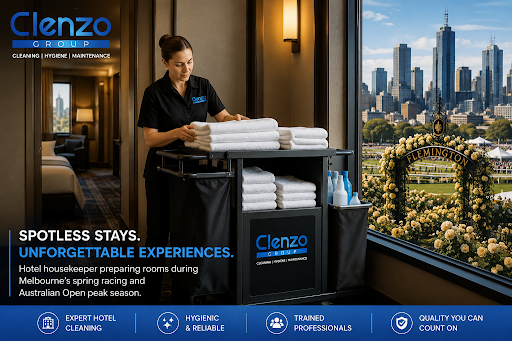
It’s the first week of September, which means every hotel GM in Melbourne is looking at the same wall of dates. AFL finals are underway. The Grand Final is at the MCG on Saturday 26 September. Spring Racing Carnival follows in late October, with Melbourne Cup Day on Tuesday 3 November. Then the summer run: Boxing Day Test, New Year’s Eve, and the Australian Open from 11 to 31 January 2027.
If your housekeeping roster for that stretch still says “TBC”, this is the fortnight to fix it. Not because of some abstract planning principle, but because the labour you’ll need simply won’t be available if you start looking in late October. Everyone else in the city will be looking too.
Here’s how we’d think about it, with the actual numbers.
The dates that break housekeeping rosters
Melbourne’s peak isn’t one season, it’s a series of spikes with quiet-ish gaps between them:
– Grand Final weekend, 25–26 September 2026. The Friday before the Grand Final is a Victorian public holiday, so you’re paying penalty rates on your busiest changeover day of the month.
– Spring Racing Carnival, late October to early November. Cup Day (Tuesday 3 November) is another public holiday, and Cup week is arguably the single hardest week of the year to roster: full house, late checkouts, function traffic through every public space, and a workforce that would rather be at Flemington.
– Boxing Day Test and New Year’s Eve. Compressed into a week when half of Melbourne’s casual workforce is on leave or interstate.
– Australian Open, 11–31 January 2027. Three full weeks of sustained high occupancy, which is a different problem from a spike. You can push a team hard for four days. You can’t push them hard for twenty-one.
That last one deserves numbers, because the AO has outgrown most hotels’ mental model of it. More than 1.3 million fans came through the gates at AO 2026, and opening week attendance nearly doubled year on year. CoStar’s data for January 2026 showed Melbourne occupancy at 75.1% for the month with an average daily rate of $261.74, and on the peak Saturday (24 January) the city hit 93.2% occupancy at $380.74 ADR.
Read those two figures together and you see the real issue: the monthly average hides an 18-point occupancy swing. Your roster has to serve the 93% nights, not the 75% average, and then not bleed money on the Tuesdays in between.
What a Cup Day room actually costs to clean
Let’s do the maths that most blog posts skip, because it explains why peak staffing decisions go wrong.
Under the Hospitality Industry (General) Award (MA000009), the rates that took effect on 1 July 2026 put a Level 2 casual (the classification most room attendants sit in) at $33.85 an hour as a base. On a Victorian public holiday, Fair Work’s pay tools put an entry-level hospitality worker at roughly $59 to $66 an hour depending on classification and employment type. Add the 12% superannuation guarantee on top, plus WorkCover and payroll tax if the staff are yours.
Now apply that to a real property. Say you run 120 rooms and Cup eve leaves you at 95% occupancy: 114 rooms to service on the public holiday, roughly 90 departures and 24 stayovers. At 30 minutes per departure clean and 15 per stayover, that’s about 51 labour hours for rooms, plus call it 10 more for public areas, lobby presentation and floaters. Around 61 hours of housekeeping labour for the day.
On a normal Tuesday, 61 casual hours costs you roughly $2,100 in wages. On Cup Day, the same 61 hours lands somewhere around $3,700 to $4,000 before super. One day, one property, and the public holiday premium alone is the price of a decent commercial vacuum.
Here’s the part that’s inconvenient for everyone, including us: outsourcing doesn’t make that premium disappear. Any provider paying its people legally is paying the same award, and a quote that shows a flat hourly rate across Cup Day should worry you more than a higher one, because the money is coming from somewhere. What outsourcing changes is everything around the premium: you buy the 61 hours you need on the day, instead of carrying a peak-sized team through the flat weeks of October and February as well. We stepped through that full comparison in our guide to in-house versus outsourced housekeeping in melbourne, and the honest summary is that the hourly rates are similar; the saving is in matching cost to occupancy.
Four ways to cover the peak, and where each one hurts
Overtime for your core team. Fast to arrange and quality stays high, since these people already know your property. But award overtime runs at 150% for the first two hours and 200% after that, and a team that carried Grand Final weekend on overtime will be running on fumes by Cup week. Fatigue shows up in your room inspection scores before it shows up in resignations.
Hiring casuals directly. The right answer if you can pull it off, but recruitment lead times in hospitality are brutal right now, and every hotel in the city is fishing in the same pond at the same time. If you start advertising in mid-October for Cup week, you’re choosing from whoever the other 200 properties didn’t take. Realistically, direct hiring for the spring peak needed to start in August. For the Australian Open, you still have time, but only just.
Agency top-ups shift by shift. Useful as a pressure valve, expensive as a plan. You’ll pay agency margin on top of penalty rates, you get different faces every shift, and your executive housekeeper spends the busiest days of the year inducting strangers instead of checking rooms.
A housekeeping partner with occupancy-matched rostering. This is what we do, so discount accordingly, but the structural advantage is real: a provider serving multiple Melbourne properties can hold a larger trained pool than any single hotel can justify, and move hours to where the occupancy is. The trade-off is lead time. A partner who meets you in September can build your Cup week and AO rosters properly. One you call in the last week of October is just a more expensive agency. Our hotel housekeeping service works best when it’s planned against your forward bookings, not summoned during a crisis.
The timeline that actually works
Now, early September. Lock the Grand Final weekend roster this week, including the public holiday Friday. Confirm your occupancy forecast for Cup week with whoever supplies your labour, in writing, with room numbers attached. If you’re considering outsourcing for summer, start conversations now; onboarding a provider properly takes four to six weeks.
Mid to late September. Get public areas deep cleaned before finals crowds arrive, not after they leave. Lobby, lifts, function spaces and bathrooms take the hardest traffic of the year across finals and Carnival, and scheduled public area cleaning in melbourne is much cheaper than the emergency version.
Early October. Check linen par levels against Cup week forecasts. High occupancy plus late checkouts plus function traffic will find every weakness in your linen cycle, and running out of king sheets on the Monday before the Cup is a self-inflicted wound. If laundry is your recurring pain point, our laundry management service covers par calculations for exactly this scenario.
November, after the Carnival. Debrief while it’s fresh. Which days blew out? Where did quality slip? This is also when to sanity-check your costs against market rates ; our 2026 housekeeping cost guide has the current benchmarks.
December. Build the AO roster as a three-week campaign, not a big weekend. Sustained occupancy means planned days off, rotation, and a supervision structure that doesn’t depend on one heroic executive housekeeper. Put a formal quality cadence in place before the tournament, because you won’t have time to invent one during it. Structured room inspections and reporting are what keep standards up when a third of the floor team is new.
The uncomfortable truth about peak season
You will pay more for housekeeping labour between late September and the end of January. There’s no structure, in-house or outsourced, that makes award penalty rates and a tight labour market cost nothing. The decision you actually control is whether you pay more only when the rooms are full, with trained people and someone else carrying the recruitment risk, or whether you pay for peak capacity all year and still scramble every October.
Hotels that treat the spring and summer calendar as a staffing project starting in September consistently come out of January with better review scores and saner cost lines than hotels that treat each event as a surprise. The calendar is published years in advance. The only variable is when you start.
Get your peak season plan sorted
If your occupancy forecast for Cup week or the Australian Open is stronger than your staffing plan, talk to us now rather than in the last week of October. We’ll look at your forward bookings and tell you honestly what we’d cover and what your own team should keep. Get in touch with Clenzo Group for a peak season housekeeping consultation.
Frequently Asked Questions
How far ahead should we arrange extra housekeeping for Melbourne Cup week?+
Six to eight weeks minimum, which means early to mid September. That allows time for site walk-throughs, room standard training and at least one trial period on normal occupancy before the Carnival. Providers and agencies alike allocate their best people to the clients who booked first.
What does housekeeping labour cost on a Victorian public holiday?+
Under the Hospitality Award rates effective 1 July 2026, entry-level hourly costs land roughly between $59 and $66 on a public holiday depending on classification and employment type, before 12% super and other on-costs. Cup Day (3 November) and Grand Final Friday (25 September) both fall in the spring peak, so budget for two premium days, not one.
Can quality survive a floor team full of temporary staff?+
Yes, but only with structure: documented room standards, a proper induction even for one-week workers, and daily inspections with scored checklists. Quality problems during peaks are usually supervision failures, not staff failures.
Does any of this apply to serviced apartments?+
Mostly yes, with one advantage: longer average stays mean fewer full departure cleans per occupied night. The AO period is where serviced apartment operators feel it most, because three weeks of near-full occupancy stresses linen and stayover servicing rather than checkout volume.