







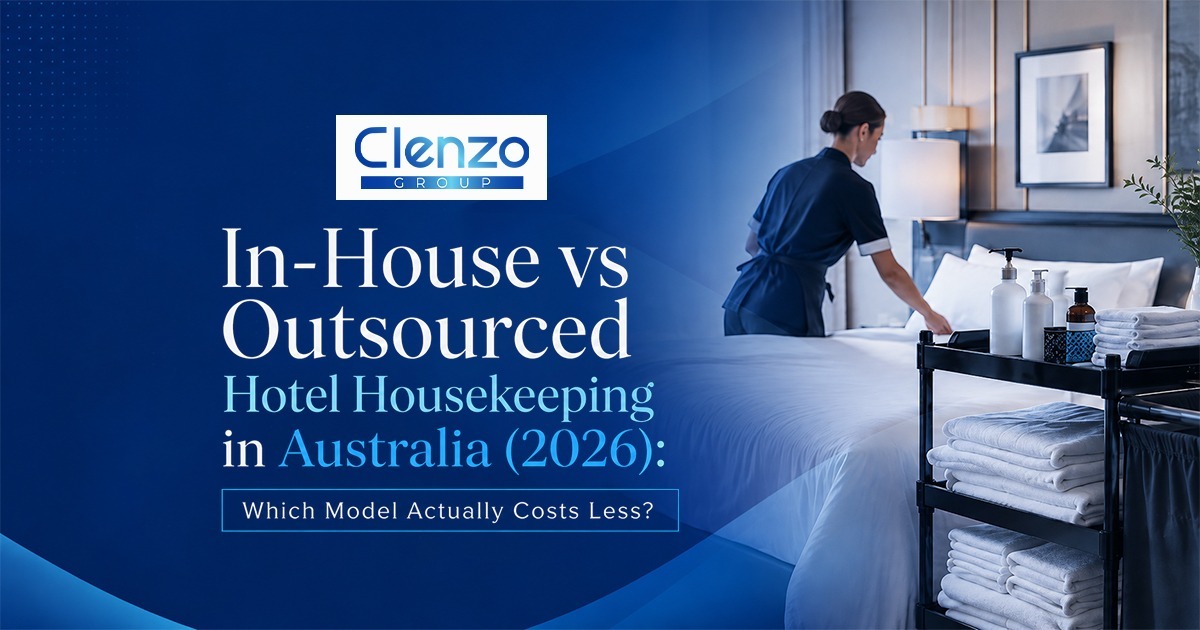
Your rooms are clean, but your wage bill keeps climbing and your roster falls apart every time occupancy spikes. If you run a hotel, motel, serviced apartment or short-stay property in Australia, the in-house versus outsourced housekeeping question stopped being philosophical the moment award rates jumped again on 1 July 2026. This guide breaks down the real numbers, compliance risks, and how to determine which model best fits your property.
Most operators we speak to have never actually cost their in-house team properly — they compare a base hourly rate against an outsourced quote and conclude outsourcing is expensive. It usually isn’t, once on-costs are loaded in. Before you commit either way, it’s worth understanding what professional hotel housekeeping services in Melbourne include and what they replace.
Not sure what your housekeeping really costs per room? Clenzo Group will benchmark your current model against a fully-costed outsourced quote — free, no obligation. Request your free quote or email info@clenzogroup.com.au.
Why This Decision Matters More in Australia in 2026
The cost equation shifted significantly this financial year:
- Award rates rose 4.75% from the first full pay period on or after 1 July 2026 under the Hospitality Industry (General) Award MA000009.
- A Level 1 guest service / attendant classification now sits at roughly $26.44/hr for full-time and part-time staff, and around $33.05/hr casual once the 25% casual loading is applied.
- Weekend and public holiday penalties apply on top — Saturdays at 125% and Sundays at 150% for permanent staff, with public holidays at 225%. Casual rates run higher again.
- Superannuation guarantee is 12% of qualifying earnings, and from 1 July 2026 Payday Super requires contributions to reach employees’ funds within seven business days of each pay run — not quarterly.
- Housekeeping is a weekend-heavy department. Your busiest servicing days are exactly the days that attract the highest penalty rates.
Put simply: the days when an in-house roster was automatically the cheap option are behind us.
What “In-House” and “Outsourced” Actually Mean
In-house housekeeping means room attendants, supervisors and a housekeeping manager sit on your payroll. You recruit, train, roster, pay, insure and manage them. You also own the linen, chemicals, trolleys and equipment.
Outsourced housekeeping means a specialist contractor supplies trained staff, supervision, systems and often equipment, and invoices you per room serviced or per hour worked. Employment, payroll compliance, workers compensation and cover for sick leave sit with the provider.
There’s also a third path — a hybrid model — where a small core in-house team handles daily servicing and a contractor covers peak periods, deep cleans, public area cleaning and specialist work. More on that below.
1. The Real Cost of an In-House Housekeeping Team
The base hourly rate is roughly two-thirds of what a room attendant actually costs you. The full picture includes:
- Superannuation at 12% of qualifying earnings
- Workers compensation premiums, which are not cheap in a manual-handling-heavy role
- Payroll tax, once your wages bill crosses the state threshold
- Annual leave, leave loading, personal leave and public holidays for permanent staff
- Recruitment and training — housekeeping turnover in Australian hospitality is notoriously high, and every replacement costs you advertising, onboarding and two to four weeks of reduced productivity
- Supervision — a housekeeping supervisor or manager salary that has to be spread across your room count
- Idle time — permanent staff are paid whether you’re at 45% occupancy or 95%
- Equipment, chemicals and linen handling, unless you already outsource laundry management
Load those on and a $26.44 base rate typically lands somewhere between $33 and $38 per productive hour before weekend penalties. Add Saturday and Sunday loadings and the effective weekend cost climbs higher again.
2. What Outsourced Housekeeping Actually Costs
Outsourced housekeeping in Australia is usually priced one of two ways:
Per room serviced. You pay a fixed rate for each departure clean or stayover service. Rates vary with room type, standard, linen handling and volume — a standard stayover in a mid-scale property sits in a very different band to a two-bedroom apartment departure clean.
Per hour. A blended hourly rate that already includes wages, super, workers comp, supervision, insurance and management overhead.
The critical difference isn’t the headline number — it’s that the outsourced rate is all-in and variable. You pay for rooms actually serviced. There’s no wage bill on a quiet Tuesday in July. For a detailed breakdown of what drives these numbers, see our guide on how much hotel housekeeping services cost in Australia.
3. Side-by-Side Comparison
| Factor | In-House Team | Outsourced Housekeeping |
| Cost structure | Fixed — paid regardless of occupancy | Variable — tied to rooms serviced |
| True hourly cost | Base rate + 25–40% on-costs | All-inclusive blended rate |
| Weekend/public holiday penalties | Paid directly by you | Built into the contract rate |
| Sick leave & absence cover | Your problem, often at overtime rates | Provider supplies replacement staff |
| Recruitment & training | Your time and budget | Handled by the provider |
| Workers comp & payroll compliance | Your legal liability | Sits with the provider |
| Scaling for peak season | Slow — recruit, induct, train | Fast — scale up within days |
| Control over standards | Direct and immediate | Managed via SLAs and audits |
| Equipment & chemicals | You purchase and maintain | Usually supplied |
| Best suited to | Large properties with stable 75%+ occupancy | Variable occupancy, seasonal demand, lean management teams |
4. Quality: The Argument That Decides It
The old objection to outsourcing was quality — that contract staff don’t care about your brand. In 2026 that argument is weaker than it used to be, for one reason: measurement.
A serious provider runs structured room audits, digital checklists and photo-verified inspections and reporting that give you a documented quality score every single day. Most in-house teams have nothing comparable — quality is whatever the supervisor noticed that morning.
Cleanliness is also the single most-mentioned factor in Australian accommodation reviews, and review scores drive rate and occupancy. If you want to see how directly this feeds your bottom line, read our breakdown of how hotel cleaning impacts guest reviews.
The right question isn’t “in-house or outsourced?” It’s “which model gives me a documented, auditable standard I can hold someone accountable to?”
5. Flexibility Is Where Outsourcing Wins Outright
Australian accommodation demand is seasonal and event-driven. A Melbourne property might run at 95% during the Grand Prix and the AFL finals, then drop to 50% in mid-winter. An in-house roster sized for peak bleeds money in the trough. Sized for the trough, it collapses under the peak.
Outsourced teams flex with your forecast. You give the provider your occupancy outlook and staffing scales accordingly — no redundancies, no frantic recruitment, no supervisors covering rooms.
6. Compliance Risk You May Be Carrying Right Now
Underpayment claims in Australian hospitality carry serious civil penalties, and housekeeping is a high-risk area — split shifts, casual conversion, penalty rate calculations, allowances and the new Payday Super timing rules. If your payroll is running on spreadsheets and goodwill, the exposure is real.
Outsourcing transfers that obligation to a provider whose entire business depends on getting it right. That isn’t a small benefit — it’s often the deciding factor for owner-operators without a dedicated HR function.
7. When In-House Still Makes Sense
Outsourcing isn’t automatically right. Keep it in-house if:
- You run a large property with stable, high year-round occupancy where fixed cost is efficiently absorbed
- Your brand standard demands highly bespoke service rituals that take months to train
- You already have a strong housekeeping manager and low turnover — that’s a genuine asset
- You operate at a luxury tier where housekeeping is a core part of the guest relationship
Many properties land on a hybrid: core in-house team for daily servicing, contractor for peaks, turndown services, deep cleans and specialist work.
Common Mistakes Operators Make
- Comparing base wage to contract rate. Always compare fully-loaded cost per occupied room, not hourly rates.
- Ignoring idle time. Paying permanent staff through low-occupancy months is a real, recurring cost.
- Choosing on price alone. The cheapest quote usually means understaffing, which shows up in your review scores within a month.
- No SLA or audit process. Outsourcing without measurable standards and reporting is how quality slips.
- Forgetting linen and equipment. Confirm what’s included before you compare quotes.
- Switching everything overnight. Trial the model on one floor or one wing first.
Why Hotels Choose Clenzo Group
- Melbourne-based hospitality specialists — we clean hotels, not offices, and the standards are not the same
- Full-service scope under one contract: housekeeping, public area cleaning, stewarding, laundry, minibar, amenities and turndown
- Documented quality control with structured inspections and reporting, not verbal assurances
- Trained, verified staff with compliant employment and full insurance cover
- Scalable rostering that flexes with your occupancy forecast
- Transparent per-room or hourly pricing with no hidden extras
- 100% satisfaction guarantee — if a standard isn’t met, we return and fix it
Learn more about Clenzo Group and how we support hotels, resorts and serviced apartments across Melbourne.
The Bottom Line
For most Australian properties in 2026, the maths now favours outsourcing — not because contractors are cheap, but because rising award rates, 12% super, Payday Super and weekend penalties have made fixed in-house rosters expensive and inflexible. The exception is high-occupancy, high-touch properties where housekeeping is genuinely part of the brand.
Don’t guess. Cost your current model per occupied room and put it beside a real quote.
Get a free, no-obligation housekeeping quote for your property. Contact Clenzo Group or email info@clenzogroup.com.au — we’ll benchmark your current costs and show you exactly what changes.
Frequently Asked Questions
Is outsourced hotel housekeeping cheaper than in-house in Australia?+
For most properties with variable occupancy, yes. In-house costs are fixed and load 25–40% of on-costs on top of the base award rate — superannuation, workers compensation, payroll tax, leave and supervision. Outsourced housekeeping is billed per room serviced or at an all-inclusive hourly rate, so cost moves with demand. Large properties with stable year-round occupancy above roughly 75% may still find in-house more efficient. The only reliable comparison is fully-loaded cost per occupied room.
What does outsourced hotel housekeeping usually include?+
A typical contract covers guest room servicing and departure cleans, bathroom sanitisation, linen changes, restocking of amenities, and supervision. Most providers also offer public area cleaning, stewarding, laundry management, minibar servicing, turndown and periodic deep cleaning. Equipment, chemicals and consumables are commonly supplied by the provider, though this varies. Always confirm scope, linen handling and inclusions in writing before comparing quotes between providers.
Do I lose control of quality if I outsource housekeeping?+
Not if the contract is set up properly. Insist on a service level agreement with defined room standards, daily or weekly audit reporting, photo verification, and an escalation process for failures. A professional provider delivers more documented quality data than most in-house teams produce, because auditing is how they retain the contract. Control comes from measurement and reporting, not from who signs the payslip.
Can I use both in-house and outsourced housekeeping?+
Yes — the hybrid model is common in Australian hotels. A small permanent team handles daily servicing and brand-specific service rituals, while a contractor covers peak occupancy, weekends, deep cleans, public area cleaning and specialist work such as carpet and floor restoration. This caps your fixed wage exposure while retaining in-house knowledge, and it’s often the lowest-risk way to trial an outsourcing partner before committing fully.
How quickly can an outsourced housekeeping team start?+
Most providers can mobilise a small property within one to two weeks, covering site induction, standards training, roster planning and equipment setup. Larger or multi-site properties usually run a phased transition over three to four weeks. Peak-season scale-ups on an existing contract can often be arranged within days, which is the main operational advantage over recruiting and inducting permanent staff.